


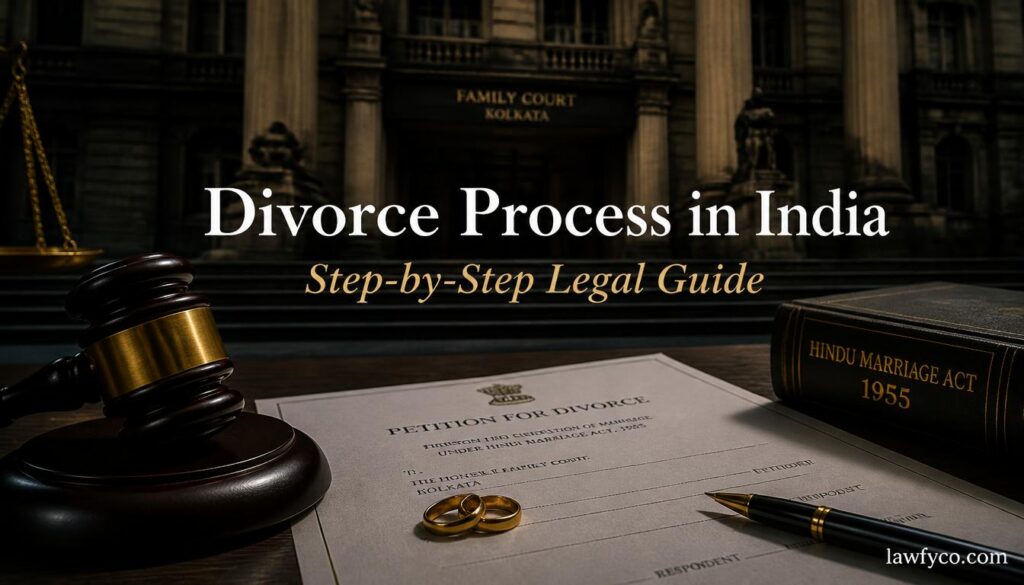
Divorce is one of the most significant legal decisions a person can make, and the process of getting a divorce in India involves navigating a body of law that varies depending on the religion of the parties, whether the divorce is by mutual consent or contested, and which court has jurisdiction. Understanding the process clearly at the outset makes a difficult situation more manageable.
This guide covers the complete divorce process in India, including the grounds for divorce, the difference between mutual consent and contested divorce, the step-by-step filing procedure, the timeline involved, and specific considerations for those in Kolkata and West Bengal.
Key Insights
Table of Contents
Grounds for Divorce in India
The grounds on which a divorce can be sought depend on the personal law applicable to the parties. Under the Hindu Marriage Act, 1955, either spouse can file for divorce on the following grounds:
Cruelty: Physical or mental cruelty by the respondent spouse. Mental cruelty is broadly interpreted by Indian courts and includes persistent humiliation, false accusations of adultery, and conduct that makes cohabitation unreasonably difficult.
Adultery: Voluntary sexual intercourse by the respondent with a person other than the spouse. Under the Hindu Marriage Act, adultery is a ground for divorce but is not a criminal offence following the Supreme Court’s decision in Joseph Shine v. Union of India (2018).
Desertion: Willful abandonment of the petitioner by the respondent for a continuous period of not less than two years immediately before the filing of the divorce petition, without reasonable cause and without the petitioner’s consent.
Conversion: Conversion of the respondent to another religion.
Unsoundness of mind: Where the respondent has been incurably of unsound mind, or has been suffering from mental disorder of such a kind and extent that the petitioner cannot reasonably be expected to live with the respondent.
Renunciation of the world: Where the respondent has renounced the world by entering a religious order.
Presumption of death: Where the respondent has not been heard of as being alive for a period of seven years or more.
In addition to the above grounds available to both spouses, a wife can seek divorce on the following additional grounds under Section 13(2) of the Hindu Marriage Act:
Types of Divorce in India: Mutual Consent vs Contested
Mutual Consent Divorce
A mutual consent divorce is one where both spouses agree to end the marriage and have reached a settlement on all ancillary issues including maintenance, custody of children, and division of assets. It is significantly faster and less adversarial than a contested divorce. Under the Hindu Marriage Act, mutual consent divorce is available under Section 13B. The essential requirements are that the parties must have been living separately for at least one year immediately before the petition, they must not have been able to live together, and they must mutually agree that the marriage should be dissolved.
Contested Divorce
A contested divorce is one where one spouse seeks divorce on a specific ground under the applicable personal law and the other spouse either contests the ground or contests ancillary issues such as maintenance, custody, or property division. Contested divorces are significantly more time-consuming and emotionally demanding than mutual consent divorces.
Mutual Consent Divorce vs Contested Divorce
Which Law Applies to Your Divorce?
Step-by-Step Divorce Process in India
Before filing for divorce, it is important to understand the grounds available, the procedure applicable to your personal law, the likely timeline and costs, and the ancillary issues of maintenance, custody, and property that will need to be resolved.
Family courts in India are required to make an attempt at reconciliation before proceeding with a divorce petition. Where children are involved, mediation is particularly important for reaching a custody arrangement that serves their best interests.
The divorce petition is a formal legal document filed before the Family Court having jurisdiction over the case. It must set out the facts of the marriage, the ground or grounds for divorce, the relief sought, and any ancillary reliefs such as maintenance and custody. For a mutual consent divorce, both parties sign a joint petition.
In a contested divorce, after the petition is filed, the court issues notice to the respondent requiring them to appear and file a written statement. The respondent has an opportunity to contest the grounds or the ancillary claims.
In a contested divorce, both parties present their evidence including witnesses, documents, and affidavits before the court. The quality and completeness of the evidence presented is critical to the outcome.
After evidence is complete, both parties present their final arguments and the court pronounces its judgment. If divorce is granted, the court passes a decree of divorce.
The divorce decree is the formal court order dissolving the marriage. A certified copy of the decree is the official document confirming that the divorce has been granted. Both parties should obtain certified copies for their records.
Mutual Consent Divorce Procedure in India
The mutual consent divorce procedure under Section 13B of the Hindu Marriage Act proceeds as follows:
First Motion: Both spouses file a joint petition before the Family Court. The court records the statements of both parties. After recording the statements, the court imposes a cooling-off period of six months before the second motion can be filed. The Supreme Court has held in Amardeep Singh v. Harveen Kaur (2017) that the six-month cooling-off period can be waived by the court where the parties have been living separately for a long period and the marriage has irretrievably broken down.
Second Motion: After the six-month period (or earlier if waived), both parties appear before the court again and confirm their consent to the divorce. If consent is confirmed, the court passes a decree of divorce by mutual consent.
The entire mutual consent divorce process typically takes between six months and one and a half years from the date of filing, depending on the workload of the Family Court and whether the cooling-off period is waived.
Contested Divorce Procedure in India
A contested divorce involves the following stages before the Family Court:
A contested divorce typically takes between two and five years, though complex cases can take longer depending on the issues involved and the workload of the Family Court.
How to Apply for Divorce Online in India
The e-filing facility for family court matters is available in many courts across India. In West Bengal, the High Court at Calcutta and the Family Courts have progressively expanded their e-filing facilities. The process for e-filing a divorce petition involves:
It is important to note that even where e-filing is available, both parties must appear in person before the court at key stages of the proceedings, particularly in mutual consent divorces where personal statements must be recorded by the court.

Divorce Process in Kolkata and West Bengal
Divorce petitions in Kolkata and West Bengal are filed before the Family Court having jurisdiction over the area where the parties reside or where the marriage was solemnised. The Family Court in Kolkata has jurisdiction over matrimonial disputes arising within Kolkata. For parties residing in other districts of West Bengal, the Family Court in the respective district is the appropriate forum.
Practical considerations for Kolkata:
Documents Required for Divorce in India
Also Read
Frequently Asked Questions
What is the divorce process in India?
The divorce process in India depends on whether the divorce is by mutual consent or contested, and on the personal law applicable to the parties. For a mutual consent divorce under the Hindu Marriage Act, both spouses file a joint petition before the Family Court, appear for a first motion where their statements are recorded, and then appear again after a cooling-off period of six months for the second motion, after which the court passes a decree of divorce. For a contested divorce, one spouse files a petition on a specific ground, the other spouse is served notice and has the opportunity to file a written statement, and the case proceeds through evidence and arguments before the court passes judgment.
What is the mutual consent divorce procedure in India?
The mutual consent divorce procedure in India under Section 13B of the Hindu Marriage Act requires that both spouses have been living separately for at least one year, that they have mutually agreed that the marriage has broken down, and that they jointly file a petition before the Family Court. After the first motion where both parties’ statements are recorded, there is a six-month cooling-off period before the second motion. The Supreme Court has held that this period can be waived by the court where the marriage has irretrievably broken down. After the second motion, the court passes a decree of divorce by mutual consent.
How to file for divorce in India?
To file for divorce in India, identify the applicable personal law and the ground or grounds for divorce, seek advice from a qualified legal professional on the procedure and the documents required, draft the divorce petition setting out the facts and the relief sought, and file the petition before the Family Court having jurisdiction over the case. The appropriate court is the Family Court in the district where either party resides or where the marriage was solemnised. Court fees must be paid along with the petition.
What are the divorce laws in India for women?
Under the Hindu Marriage Act, 1955, women have the same rights as men to file for divorce on any of the grounds available under the Act. In addition, women have certain additional grounds for divorce including bigamy by the husband, the husband having committed rape, sodomy, or bestiality after marriage, and the wife having repudiated a marriage solemnised when she was below 15 years of age. Women are also entitled to seek maintenance during and after the divorce proceedings under the applicable personal law and under Section 125 of the Bharatiya Nagarik Suraksha Sanhita, 2023. Following a decree of divorce, a wife can seek permanent alimony and maintenance under Section 25 of the Hindu Marriage Act.
How long does the divorce process take in India?
A mutual consent divorce typically takes between six months and one and a half years from the date of filing, depending on whether the six-month cooling-off period is waived and the workload of the Family Court. A contested divorce typically takes between two and five years, and can take longer in complex cases involving extensive evidence or appeals. The timeline depends significantly on the specific Family Court’s caseload and the complexity of the ancillary issues such as maintenance and custody.
What is a divorce notice in India?
A divorce notice in India refers to a legal notice sent by one spouse to the other before or alongside the filing of a divorce petition, informing the other party of the intention to seek divorce and the grounds on which it is being sought. While a formal divorce notice is not a statutory requirement before filing a petition, it is commonly used as a preliminary step to put the other party on notice of the claim. The divorce notice sets out the facts of the case and the relief being sought and gives the other party an opportunity to respond before formal proceedings are initiated.
What is the divorce petition format in India?
A divorce petition in India is a formal court document that must contain the names and addresses of both parties, the date and place of marriage, details of children if any, the facts of the case, the ground or grounds for divorce, and the specific relief sought. In a mutual consent divorce, the petition is jointly filed by both parties and must also contain the terms of the settlement agreed between them on maintenance, custody, and property. The petition is filed on stamp paper of the prescribed value and must be accompanied by the required supporting documents and the court fee.
The information in this article is for general informational purposes only and does not constitute legal advice. No attorney-client relationship is formed by reading this content.
Related Insights

Section 406 IPC: Criminal Breach of Trust and How It Differs from Cheating (Surat)
A guide to Section 406 IPC and BNS 316 covering criminal breach of trust, punishment, bail, the difference from cheating, partnership disputes and Surat courts.
Read Article →
Delhi High Court POCSO Case: POCSO Sentence Suspension Granted During Pendency of Appeal
Read Article →
Forgery under IPC Sections 463 to 471 and BNS: Punishment and Defences (Surat)
A guide to forgery under IPC 463 to 471 and BNS 335 to 340: punishment, bail, the Supreme Court on false documents, defences and forgery cases in Surat.
Read Article →