


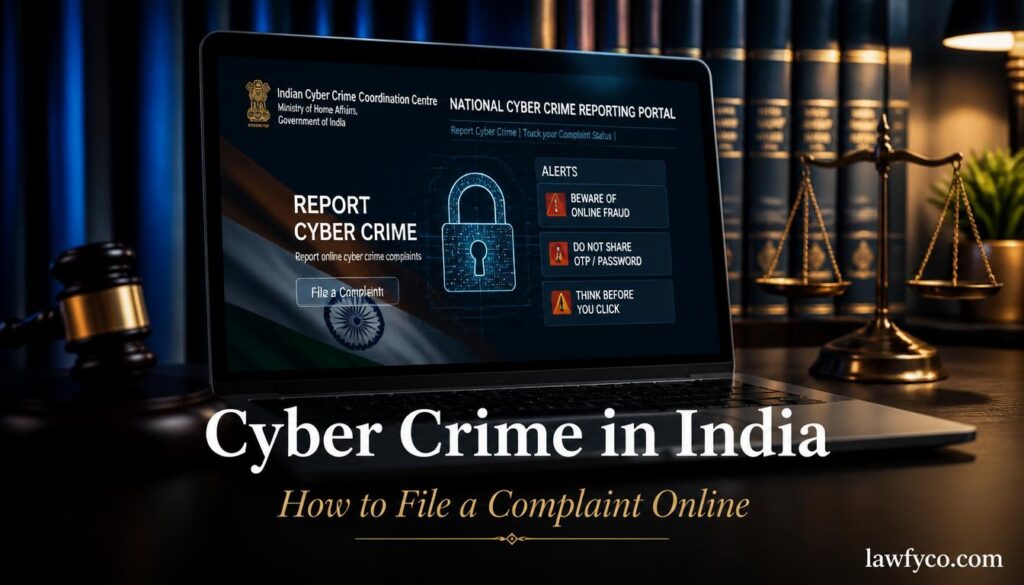
Cyber crime in India is rising sharply. Online fraud, identity theft, phishing, social media hacking, investment scams, and digital harassment are among the most frequently reported offences. The government has created a dedicated mechanism for reporting cyber crime through the National Cyber Crime Reporting Portal (cybercrime.gov.in), the national helpline number 1930, and local cyber cells attached to police stations across the country.
This guide covers the types of cyber crime in India, how to file a cyber crime complaint online, how to use the NCRP portal, the cyber crime helpline number, and the legal framework that applies to cyber offences in India.
Key Insights
Table of Contents
What is Cyber Crime in India?
Cyber crime refers to any criminal offence that involves a computer, a network, or a digital device, whether as the tool used to commit the offence or as the target of the offence. Cyber crime in India encompasses a broad range of conduct, from online financial fraud and identity theft to hacking, cyberstalking, child sexual abuse material, and ransomware attacks.
The rise of digital payments, social media, e-commerce, and remote work has expanded the attack surface significantly. According to data from the Ministry of Home Affairs, cyber fraud complaints in India have been increasing year on year, with financial fraud being the dominant category. The government has responded by establishing the Indian Cyber Crime Coordination Centre (I4C) under the Ministry of Home Affairs and the National Cyber Crime Reporting Portal (NCRP) as the single window for reporting cyber crime across India.
Types of Cyber Crime in India
Online Financial Fraud
Online financial fraud is the most commonly reported category of cyber crime in India. It includes UPI fraud, OTP fraud, phishing (fake websites or messages that trick victims into revealing banking credentials), vishing (voice calls impersonating bank officials or government agencies), investment scams (fraudulent trading apps and platforms promising high returns), and loan app fraud.
Identity Theft and Account Hacking
Identity theft involves the unauthorised use of another person’s identity, credentials, or personal information. Account hacking involves gaining unauthorised access to another person’s email, social media, or banking account. Both are offences under the Information Technology Act, 2000 and the Bharatiya Nyaya Sanhita, 2023.
Cyberstalking and Online Harassment
Cyberstalking involves the repeated use of digital communication to harass, intimidate, or threaten another person. Online harassment includes sending abusive messages, creating fake profiles, morphing images, and making threats through social media or messaging apps. These offences are punishable under the Bharatiya Nyaya Sanhita, 2023.
Ransomware and Malware Attacks
Ransomware attacks encrypt a victim’s data and demand payment in exchange for the decryption key. Malware attacks involve the installation of malicious software on a victim’s device without their knowledge. These attacks target individuals, businesses, and government systems.
Online Defamation and Fake News
Publishing false statements about a person online with the intention of harming their reputation is online defamation and is punishable under the Bharatiya Nyaya Sanhita, 2023. Spreading misinformation or fake news can also constitute an offence in certain circumstances.
Child Sexual Abuse Material
The creation, storage, or distribution of child sexual abuse material is a serious offence under the Protection of Children from Sexual Offences Act, 2012 (POCSO) and the Information Technology Act, 2000. Complaints involving child sexual abuse material are given priority on the NCRP portal and are investigated urgently.
Cyber Crime Related to Social Media
Social media-related cyber crimes include hacking of accounts, posting morphed or obscene images, creating fake profiles, extortion using compromising content (also called sextortion), and incitement to violence through social media posts.
Cyber Crime Laws in India
Cyber crime in India is governed by the following legislation:
How to File a Cyber Crime Complaint Online in India
For financial fraud, report the incident immediately. The national cyber crime helpline number 1930 is operational 24 hours a day. Calling 1930 within the first hour of a fraud significantly increases the chances of the fraudulent amount being frozen before it is transferred further.
Go to the National Cyber Crime Reporting Portal at cybercrime.gov.in. This is the government’s official portal for reporting all types of cyber crime across India. The portal is available in both English and Hindi.
The NCRP portal has two main categories for filing a complaint: “Report Women/Child Related Crime” and “Report Other Cyber Crimes”. Financial fraud, hacking, identity theft, and social media related offences fall under “Other Cyber Crimes”.
Click on “File a Complaint” and register on the portal with your mobile number. Complete the complaint form by providing your personal details, the details of the incident (date, time, how the fraud occurred), the amount involved if applicable, the details of the accused (phone number, UPI ID, bank account details) if known, and uploading any supporting evidence such as screenshots, transaction IDs, and call recordings.
After submitting the complaint, you will receive a complaint acknowledgement number. Note this number carefully as it is used to track the status of your complaint on the portal.
Check the status of your complaint by logging into the NCRP portal and using the complaint number. If your complaint requires urgent attention, you can also approach the cyber cell of the local police station.

How to Use the National Cyber Crime Reporting Portal (cybercrime.gov.in)
The National Cyber Crime Reporting Portal at cybercrime.gov.in is the single window for filing cyber crime complaints in India. Here is how to navigate it:
Registration: Click on “File a Complaint” and then “Report Other Cyber Crime”. You will be asked to register with your mobile number. An OTP will be sent to verify your number.
Complaint form: The form requires the following information: your state and district, the category of offence (financial fraud, hacking, online harassment, and so on), the date and time of the incident, a description of what happened, details of the suspect if known (phone number, email, UPI ID, social media handle, bank account details), and the amount involved if applicable.
Evidence upload: Upload screenshots of messages, emails, or posts, transaction statements, call recordings where available, and any other evidence of the offence.
Submission and acknowledgement: After submission, the complaint is assigned to the cyber cell of the relevant state police for investigation. You receive a complaint number for tracking.
Cybercrime.gov.in complaint status: Log in to the portal and enter your complaint number to check the current status of your complaint.
Cyber Crime Helpline Number India
The national cyber crime helpline number in India is 1930. This number is operated by the Indian Cyber Crime Coordination Centre (I4C) under the Ministry of Home Affairs and is available 24 hours a day, 7 days a week.
When to call 1930:
In addition to the national helpline, each state police force has a dedicated cyber cell that handles cyber crime complaints. The contact details for state cyber cells are available on the respective state police websites.
How to Report Cyber Fraud in India
Cyber fraud in India covers UPI fraud, OTP fraud, phishing, investment scams, lottery fraud, and online shopping fraud, among others. Here is how to report it:
Call 1930 immediately. Provide details of the fraud, the amount lost, the account from which the money was debited, and any information about the fraudster’s phone number or UPI ID. The helpline team attempts to freeze the fraudulent transaction with the beneficiary bank before the money is moved further.
File on cybercrime.gov.in. Complete the complaint form on the NCRP portal. For financial fraud, select “Financial Fraud” as the category and provide the transaction details, the fraudster’s details if known, and upload your bank statement and screenshots of any messages.
Approach the local cyber cell. If the online complaint does not yield results or the matter requires urgent physical intervention, approach the cyber cell of the nearest police station with a written complaint and all documentary evidence.
Cyber Crime Complaint for Instagram and Social Media
Social media-related cyber crimes including hacking of Instagram, Facebook, or WhatsApp accounts, fake profiles, posting morphed images, sextortion, and online harassment can be reported as follows:
Report to the platform first. Use the platform’s reporting mechanism to report the offensive content or the fake profile. Instagram, Facebook, and WhatsApp have in-app reporting tools that allow users to flag offensive content and accounts. This can lead to the content being removed or the account being suspended.
File a complaint on cybercrime.gov.in. Under “Report Other Cyber Crimes”, select the relevant category (online harassment, hacking, or content related offence) and provide details of the incident including the URL of the offensive content, screenshots, and the username or profile details of the accused.
Approach the local cyber cell. For serious offences including threats, morphed images, or sextortion, approaching the local cyber cell in person and filing a written complaint ensures the matter is taken up urgently.
How to Check Cyber Crime Complaint Status
To check the status of a cyber crime complaint filed on cybercrime.gov.in:
If the complaint status has not been updated for a long time, or if you require urgent attention, contact the cyber cell of the state police in your state directly.
Frequently Asked Questions
How to file a cyber crime complaint in India?
To file a cyber crime complaint in India, visit the National Cyber Crime Reporting Portal at cybercrime.gov.in and register with your mobile number. Select the category of offence, complete the complaint form with details of the incident and the suspect, upload any supporting evidence such as screenshots and transaction details, and submit. You will receive a complaint acknowledgement number to track the status of your complaint. For financial fraud, call 1930 immediately before filing online.
What is the cyber crime helpline number in India?
The national cyber crime helpline number in India is 1930. It is operated by the Indian Cyber Crime Coordination Centre (I4C) under the Ministry of Home Affairs and is available 24 hours a day, 7 days a week across all states and union territories. For financial fraud, calling 1930 immediately after the incident significantly improves the chances of recovering the fraudulent amount.
What is the NCRP portal for cyber crime complaints?
The NCRP (National Cyber Crime Reporting Portal) is the government’s official portal at cybercrime.gov.in for filing cyber crime complaints across India. It is a single window that routes complaints to the cyber cell of the relevant state police for investigation. The portal covers all categories of cyber crime including financial fraud, hacking, online harassment, social media related offences, and child sexual abuse material.
How to report cyber fraud in India?
To report cyber fraud in India, call 1930 immediately after the incident to attempt to freeze the fraudulent transaction. Then file a complaint on cybercrime.gov.in by selecting “Financial Fraud” as the category and providing details of the transaction, the fraudster’s phone number or UPI ID if known, and uploading your bank statement and screenshots of any messages. You can also approach the cyber cell of the nearest police station with a written complaint and all documentary evidence.
What is the cyber crime complaint number for Instagram?
There is no separate complaint number specifically for Instagram-related cyber crimes. Social media cyber crimes including Instagram account hacking, fake profiles, and posting of morphed images are reported on the National Cyber Crime Reporting Portal at cybercrime.gov.in under “Report Other Cyber Crimes”. You should also report the content to Instagram directly using the in-app reporting tool.
How to check cyber crime complaint status in India?
To check the status of a cyber crime complaint in India, visit cybercrime.gov.in, click on “Report and Track”, log in with your registered mobile number, and enter your complaint acknowledgement number. The portal displays the current status of the complaint. If the status has not been updated, you can contact the cyber cell of the state police in your state directly.
What are the cyber crime laws in India?
Cyber crime in India is governed by the Information Technology Act, 2000, which covers hacking, identity theft, publishing obscene material online, and violation of privacy, among others. The Bharatiya Nyaya Sanhita, 2023 covers cyber-related cheating, extortion, defamation, and criminal intimidation. The Protection of Children from Sexual Offences Act, 2012 applies to cyber crimes involving children. The penalties under these laws range from fines to imprisonment of several years depending on the nature and severity of the offence.
The information in this article is for general informational purposes only and does not constitute legal advice. No attorney-client relationship is formed by reading this content.
Related Insights

Section 406 IPC: Criminal Breach of Trust and How It Differs from Cheating (Surat)
A guide to Section 406 IPC and BNS 316 covering criminal breach of trust, punishment, bail, the difference from cheating, partnership disputes and Surat courts.
Read Article →
Delhi High Court POCSO Case: POCSO Sentence Suspension Granted During Pendency of Appeal
Read Article →
Forgery under IPC Sections 463 to 471 and BNS: Punishment and Defences (Surat)
A guide to forgery under IPC 463 to 471 and BNS 335 to 340: punishment, bail, the Supreme Court on false documents, defences and forgery cases in Surat.
Read Article →