


Last reviewed: November 2026
A cheque that comes back unpaid is a common problem in business dealings. In a trading city such as Surat, cheques are one of the ways in which traders are paid, so knowing what to do when a cheque is dishonoured matters to the person who gave it and to the person who received it. The law treats certain dishonoured cheques as a criminal offence under Section 138 of the Negotiable Instruments Act, 1881 (NI Act).
This guide explains the cheque bounce case procedure under Section 138 of the NI Act, the time limits for the legal notice and the complaint, cheque bounce punishment, cheque bounce charges, a sample cheque bounce message, and where a cheque bounce case in Surat is filed.
Key Insights
Table of Contents
Received a bounced cheque or a legal notice in Surat?
Speak to the Lawfy & Co. Surat team about your matter.
What Is a Cheque Bounce? (Meaning)
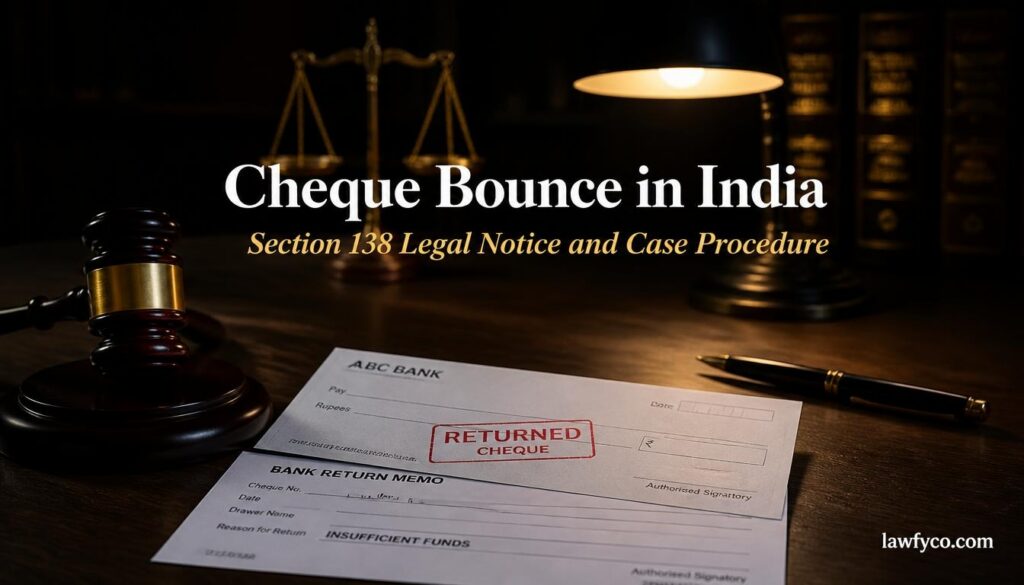
A cheque bounce, also called cheque dishonour or a cheque return, happens when the bank does not pay a cheque that has been presented to it. The bank issues a return memo stating the reason for the return.
Not every returned cheque is a criminal case. Section 138 of the NI Act applies where the cheque was drawn on the drawer’s own account for the discharge, wholly or partly, of a legally enforceable debt or other liability, and it was returned because the funds in the account are insufficient or because the amount exceeds the arrangement made with the bank. The reason noted in the return memo is therefore important.
The complaint is made by the payee or the holder in due course, and the person prosecuted is the drawer of the cheque.
Section 138 of the Negotiable Instruments Act: Conditions for the Offence
For an offence under Section 138 of the NI Act, all of the following conditions must be satisfied:
If the drawer pays within the 15 days, no offence under Section 138 is made out. A cheque that is still within its validity can also be presented again, which starts the process afresh.
Cheque Bounce Timeline at a Glance
Cheque Bounce Punishment
The cheque bounce punishment under Section 138 is imprisonment for a term that may extend to two years, or a fine that may extend to twice the amount of the cheque, or both.
Cheque Bounce Charges and Cheque Return Charges
Cheque return charges are fees that a bank levies when a cheque is returned unpaid. They are separate from the legal consequences under Section 138.
These charges are only the bank’s fee. Cheque bounce punishment, compensation and a fine are decided by the court.
Cheque Bounce Message Format (Informal Reminder)
Many payees first send a short message to the drawer. A cheque bounce message is only a reminder. It does not replace the written legal notice that must be sent within 30 days of receiving the bank’s information.
A sample cheque bounce message format:
“Dear [Name], cheque no. [number] dated [date] for Rs. [amount], issued by you towards [purpose], was returned unpaid by [bank] on [date] with the remark [reason]. Please arrange the payment at the earliest. A formal legal notice under Section 138 of the Negotiable Instruments Act may follow.”
The statutory legal notice should state the cheque details, the date and reason of the return, and a clear demand for payment of the cheque amount within 15 days of receiving the notice.
Cheque Bounce Case Procedure: Step by Step
Note the cheque date, the amount, the date of return and the reason given by the bank. Confirm that the cheque was presented within its validity.
Send a written notice to the drawer within 30 days of receiving the bank’s information, demanding payment within 15 days. Keep proof of dispatch and delivery.
The drawer has 15 days from receiving the notice to pay. If the amount is paid in this period, no offence under Section 138 is made out.
If the drawer does not pay, file a written complaint before the Magistrate within one month from the date the cause of action arises. Keep the original cheque, the return memo, the legal notice and the proof of delivery ready.
The Magistrate takes cognizance and issues summons to the accused. The Supreme Court has directed in Sanjabij Tari (2025) that, in addition to the usual modes, summons in Section 138 cases may also be served on the accused by the complainant.
The trial is a summary trial. The complainant’s evidence can be given on affidavit under Section 145, and the court should endeavour to conclude the trial within six months.
The court may convict or acquit. After a conviction, the drawer can appeal, subject to the deposit under Section 148 discussed below.
Timelines depend on the court’s workload and the facts of the case. No outcome can be assured.

Need help with a cheque bounce case in Surat?
Our Surat office is at Athwalines, opposite the New Court. Call or WhatsApp us with the basic facts and the documents you have.
Where to File a Cheque Bounce Case in Surat
Section 142(2) of the NI Act decides the court by reference to how the cheque was presented:
So a payee whose account is at a bank branch in Surat can file a cheque bounce complaint in Surat. A section 138 case in Surat court is heard by a Magistrate of the first class at the Surat court complex in Athwalines. Before filing, note the branch where the cheque was deposited for collection, because it decides the forum.
Court buildings, filing counters and e-filing facilities change from time to time, so check with the court registry for the current location and process.
Interim Compensation, Appeal Deposit and Settlement
Common Defences in a Section 138 Case
Lawfy & Co. Surat Office
Speak to Our Surat Team
If you need guidance on a bounced cheque, a legal notice or a Section 138 complaint, call or WhatsApp the Lawfy & Co. Surat office. Share the basic facts and the documents you have, and the team will explain the possible next steps.
सूरत ऑफिस से संपर्क करें
Contacting the office does not by itself create an advocate-client relationship.
7 Hiral Arcade, 3rd Floor, Opposite New Court, Meghdoot Society, Athwalines, Athwa, Surat, Gujarat 395007
Phone: +91 91471 09222
Email: ask@lawfyco.in
WhatsApp: +91 91471 09222
Also Read
Frequently Asked Questions
What is a cheque bounce case?
A cheque bounce case is a criminal complaint under Section 138 of the Negotiable Instruments Act. It applies when a cheque issued for a legally enforceable debt or liability is returned unpaid because of insufficient funds or because it exceeds the arrangement with the bank, and the drawer does not pay after receiving the legal notice.
What is the punishment for cheque bounce?
The punishment is imprisonment up to two years, or a fine up to twice the cheque amount, or both. The offence is bailable, non-cognizable and compoundable.
What is the time limit for a cheque bounce case?
The cheque must be presented within three months or its validity, whichever is earlier. The legal notice must be sent within 30 days of receiving the bank’s information about the return. The drawer has 15 days from receiving the notice to pay. The complaint must be filed within one month after those 15 days.
Is a cheque bounce case bailable?
Yes. An offence under Section 138 is bailable and non-cognizable, so the police cannot arrest the accused without a warrant.
What are cheque bounce charges?
Cheque bounce charges, also called cheque return charges, are fees that banks levy when a cheque is returned unpaid. They vary from bank to bank and are set out in each bank’s schedule of charges. They are separate from the punishment and compensation decided by the court.
Where can I file a cheque bounce case in Surat?
A complaint is filed before a Magistrate of the first class. Under Section 142(2), if the cheque was delivered for collection through an account, the court is the one where the payee’s bank branch is located, so a payee whose account is in Surat can file at the Surat court complex in Athwalines.
Can a cheque bounce case be settled?
Yes. Under Section 147 of the NI Act, offences under the Act are compoundable, so the parties can settle the case.
हिंदी सवाल-जवाब
चेक बाउंस होने पर क्या सजा होती है?
NI Act की धारा 138 के तहत 2 साल तक की कैद, या चेक की राशि से दोगुने तक जुर्माना, या दोनों हो सकते हैं। यह अपराध जमानती है और इसमें समझौता भी हो सकता है।
चेक बाउंस का लीगल नोटिस कितने दिन में भेजना ज़रूरी है?
बैंक से चेक वापस होने की सूचना मिलने के 30 दिन के भीतर लिखित नोटिस भेजना होता है। नोटिस मिलने के बाद चेक जारी करने वाले के पास भुगतान के लिए 15 दिन होते हैं।
चेक बाउंस का केस कब दर्ज किया जा सकता है?
यदि 15 दिन में भुगतान नहीं होता, तो उस तारीख से एक महीने के भीतर अदालत में लिखित शिकायत दाखिल करनी होती है।
The information in this article is for general informational purposes only and does not constitute legal advice. No attorney-client relationship is formed by reading this content.
Related Insights
Section 406 IPC: Criminal Breach of Trust and How It Differs from Cheating (Surat)
A guide to Section 406 IPC and BNS 316 covering criminal breach of trust, punishment, bail, the difference from cheating, partnership disputes and Surat courts.
Read Article →
Delhi High Court POCSO Case: POCSO Sentence Suspension Granted During Pendency of Appeal
Read Article →
Forgery under IPC Sections 463 to 471 and BNS: Punishment and Defences (Surat)
A guide to forgery under IPC 463 to 471 and BNS 335 to 340: punishment, bail, the Supreme Court on false documents, defences and forgery cases in Surat.
Read Article →