


Last reviewed: November 2026
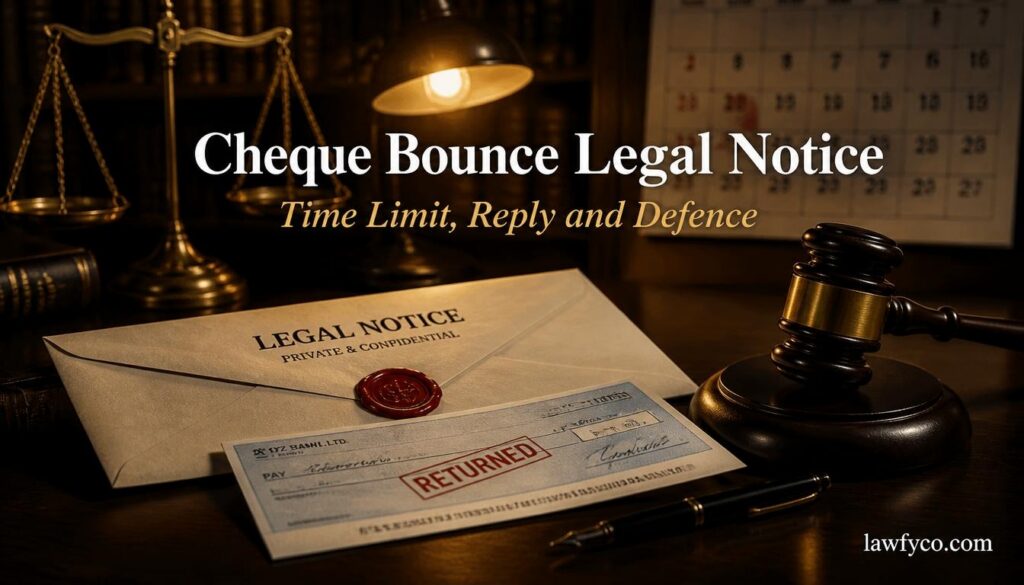
A legal notice is the step that turns a bounced cheque into a possible criminal case. Under Section 138 of the Negotiable Instruments Act, 1881 (NI Act), the payee must send a written demand within a fixed time, and the drawer gets a fixed time to pay. Missing either deadline can decide the outcome of the case. For a trader in Surat, whether you are the person who received the cheque or the person who issued it, the cheque bounce notice and its timelines are the most important part of the process.
This guide explains the cheque bounce legal notice, the cheque bounce case time limit, what the notice must contain, how it is served, how a drawer can reply, the defences available, and the recent cheque bounce rules and judgements of the Supreme Court in 2025 and 2026. For the full complaint procedure, punishment and bank charges, read our guide on the cheque bounce case under Section 138.
Key Insights
Table of Contents
Received a cheque bounce notice or need to send one in Surat?
Speak to the Lawfy & Co. Surat team about your matter.
What Is a Cheque Bounce Legal Notice? (Meaning)
A cheque bounce legal notice, also called a cheque bounce notice or a demand notice, is the written notice that the payee or holder in due course sends to the drawer after a cheque is dishonoured. It is required by the proviso to Section 138 of the NI Act. The cheque bounce law, often called the cheque bounce act, is found in Chapter XVII of the NI Act, which begins with Section 138.
The notice matters because the offence is not complete on the dishonour alone. In Kusum Ingots & Alloys v. Pennar Peterson Securities (2000), the Supreme Court clarified that the offence arises only when the drawer fails to pay within 15 days of receiving the notice. In Shakti Travel & Tours v. State of Bihar (2002), the Court underscored that a properly served legal notice is the foundation of a complaint under Section 138.
The notice serves three purposes:
Cheque Bounce Case Time Limit
A notice sent after the 30 days is time-barred, and a complaint based on it is not maintainable. A cheque that is still within its validity can be presented again, which starts the process afresh.
A complaint filed after the one month can be taken up only if the court is satisfied that the complainant had sufficient cause for the delay. In S. Nagesh v. Shobha S. Aradhya (January 2026), the Supreme Court set aside an order where the Magistrate took cognizance of a belated complaint before passing the order condoning the delay.
What the Legal Notice Must Contain
A notice that is clear and complete protects the later complaint. It should include:
A notice can be issued by an advocate or an authorised agent acting on the payee’s instructions.
The amount demanded: the demand must correspond to the cheque amount. In Kaveri Plastics v. Mahdoom Bawa Bahrudeen Noorul (2025), the Supreme Court reaffirmed that strict compliance with the wording of Section 138 is mandatory, and held that where the cheque amount and the demand in the notice do not align, the notice cannot be considered valid. In Suman Sethi v. Ajay K. Churiwal (2000), the Court held that a demand cannot be faulted if other sums, such as interest and costs, are separately indicated in addition to the cheque amount. The safe course is to demand the cheque amount clearly and to keep any other claim separate.
A vague or conditional demand, such as one that offers settlement options or part payment, can dilute the force of the notice.
How to Send the Notice and Prove Service

Need help with a cheque bounce notice or reply in Surat?
Our Surat office is at Athwalines, opposite the New Court. Call or WhatsApp us with the basic facts and the documents you have.
What Happens After the Notice: The 15-Day Window
The drawer has 15 days from receiving the notice to pay the cheque amount. If the amount is paid within this period, no offence is committed and no proceedings can be started.
If the drawer does not pay, the cause of action arises after the 15 days. The payee can then file a complaint before the Magistrate within one month. The complaint procedure, trial, punishment and settlement are explained in our guide on the cheque bounce case under Section 138.
Reply to a Cheque Bounce Notice and Defences Available
For a drawer who has received a notice, payment within the 15 days is what prevents the offence. A reply by itself does not.
A failure to reply can be held against the drawer. In Sanjabij Tari v. Kishore S. Borcar (2025), the Supreme Court stated that the accused’s failure to reply to the statutory notice led to an inference that there was some merit in the charge of dishonour. It is therefore prudent to send a written reply within the 15 days, stating the drawer’s position and keeping proof of dispatch.
Defences that can be raised in a Section 138 case include:
Common Mistakes That Make a Notice or Complaint Fail
Cheque Bounce New Rules and Recent Judgements (2025 and 2026)
If you are looking for the cheque bounce new law in India, the main statutory changes are the Negotiable Instruments (Amendment) Acts of 2015 and 2018. The recent changes in how the rules are applied come mostly from Supreme Court rulings. The table lists the key developments, including the cheque bounce latest judgement in 2026.
Cheque Issued by a Firm or Company
Where a cheque is issued on behalf of a firm or a company, Section 141 of the NI Act applies. In Dhanasingh Prabhu v. Chandrasekar (2025), the Supreme Court held that a complaint under Sections 138 and 141 is maintainable even if the partnership firm itself is not arrayed as an accused, provided the partners in charge of the business are impleaded. This makes it important to identify the persons in charge of the business when the notice is sent and the complaint is filed.
Cheque Bounce Case in Surat: Court and Reply
Under Section 142(2) of the NI Act, if the cheque was delivered for collection through an account, the complaint is filed in the court within whose jurisdiction the payee’s bank branch is located. In Jai Balaji Industries v. HEG (2025), the Supreme Court confirmed that this means the payee’s home branch. A payee whose account is at a bank branch in Surat can therefore file a cheque bounce case in Surat.
A cheque return case in Surat court is heard by a Magistrate of the first class at the Surat court complex in Athwalines, as a summary trial under Section 143. A drawer in Surat who has received a legal notice should send the cheque bounce notice reply within the 15 days.
Court buildings, filing counters and e-filing facilities change from time to time, so check with the court registry for the current location and process.
Lawfy & Co. Surat Office
Speak to Our Surat Team
If you need guidance on sending or replying to a cheque bounce notice, call or WhatsApp the Lawfy & Co. Surat office. Share the basic facts and the documents you have, and the team will explain the possible next steps.
सूरत ऑफिस से संपर्क करें
Contacting the office does not by itself create an advocate-client relationship.
7 Hiral Arcade, 3rd Floor, Opposite New Court, Meghdoot Society, Athwalines, Athwa, Surat, Gujarat 395007
Phone: +91 91471 09222
Email: ask@lawfyco.in
WhatsApp: +91 91471 09222
Also Read
Frequently Asked Questions
What is a cheque bounce legal notice?
A cheque bounce legal notice is the written notice that the payee sends to the drawer after a cheque is dishonoured, demanding payment of the cheque amount within 15 days. It is a mandatory step before a complaint under Section 138 of the NI Act can be filed.
Within how many days must the legal notice be sent?
The notice must be sent within 30 days of receiving the bank’s information about the return of the cheque. A notice sent after that is time-barred, although a cheque that is still within its validity can be presented again.
How many days does the drawer have to pay after the notice?
The drawer has 15 days from receiving the notice. If the cheque amount is paid within this period, no offence under Section 138 is committed.
What is the time limit to file a cheque bounce case?
The complaint must be filed within one month from the date the cause of action arises, that is, after the 15 days. A delayed complaint can be taken up only if the court is satisfied that there was sufficient cause for the delay and the delay is condoned.
Can a cheque bounce notice be sent by email or WhatsApp?
Courts have recognised electronic communication as supplementary proof of notice, and the Bombay High Court accepted a WhatsApp acknowledgment in SBI Cards & Payment Services v. Rohidas Jadhav (2018). It is still advisable to also send a registered or speed post copy.
What happens if the drawer does not reply to the notice?
Payment within the 15 days is what prevents the offence, and a reply alone does not. A failure to reply can also be held against the drawer. In Sanjabij Tari (2025), the Supreme Court stated that the accused’s failure to reply led to an inference that there was some merit in the charge of dishonour.
What amount should the legal notice demand?
The notice should demand the cheque amount. In Kaveri Plastics (2025), the Supreme Court held that where the demand and the cheque amount do not align, the notice cannot be considered valid. A demand is not faulted if other sums such as interest or costs are separately indicated, as held in Suman Sethi v. Ajay K. Churiwal (2000).
हिंदी सवाल-जवाब
चेक बाउंस का लीगल नोटिस कितने दिन में भेजना ज़रूरी है?
बैंक से चेक वापस होने की सूचना मिलने के 30 दिन के भीतर लिखित नोटिस भेजना होता है। नोटिस मिलने के बाद चेक जारी करने वाले के पास भुगतान के लिए 15 दिन होते हैं। भुगतान न होने पर उसके बाद एक महीने के भीतर शिकायत दाखिल करनी होती है।
चेक बाउंस के नोटिस का जवाब कब देना चाहिए?
नोटिस मिलने के 15 दिन के भीतर। इसी अवधि में भुगतान करने से अपराध नहीं बनता। जवाब न देने पर सुप्रीम कोर्ट ने Sanjabij Tari (2025) में कहा कि इससे आरोप में कुछ दम होने का अनुमान लगाया जा सकता है, इसलिए लिखित जवाब भेजना समझदारी है।
नोटिस में कितनी रकम की मांग करनी चाहिए?
नोटिस में चेक की राशि की मांग साफ़ शब्दों में करनी चाहिए। सुप्रीम कोर्ट ने Kaveri Plastics (2025) में कहा कि मांग और चेक की राशि मेल न खाने पर नोटिस वैध नहीं माना जा सकता।
The information in this article is for general informational purposes only and does not constitute legal advice. No attorney-client relationship is formed by reading this content.
Related Insights
Section 406 IPC: Criminal Breach of Trust and How It Differs from Cheating (Surat)
A guide to Section 406 IPC and BNS 316 covering criminal breach of trust, punishment, bail, the difference from cheating, partnership disputes and Surat courts.
Read Article →
Delhi High Court POCSO Case: POCSO Sentence Suspension Granted During Pendency of Appeal
Read Article →
Forgery under IPC Sections 463 to 471 and BNS: Punishment and Defences (Surat)
A guide to forgery under IPC 463 to 471 and BNS 335 to 340: punishment, bail, the Supreme Court on false documents, defences and forgery cases in Surat.
Read Article →