


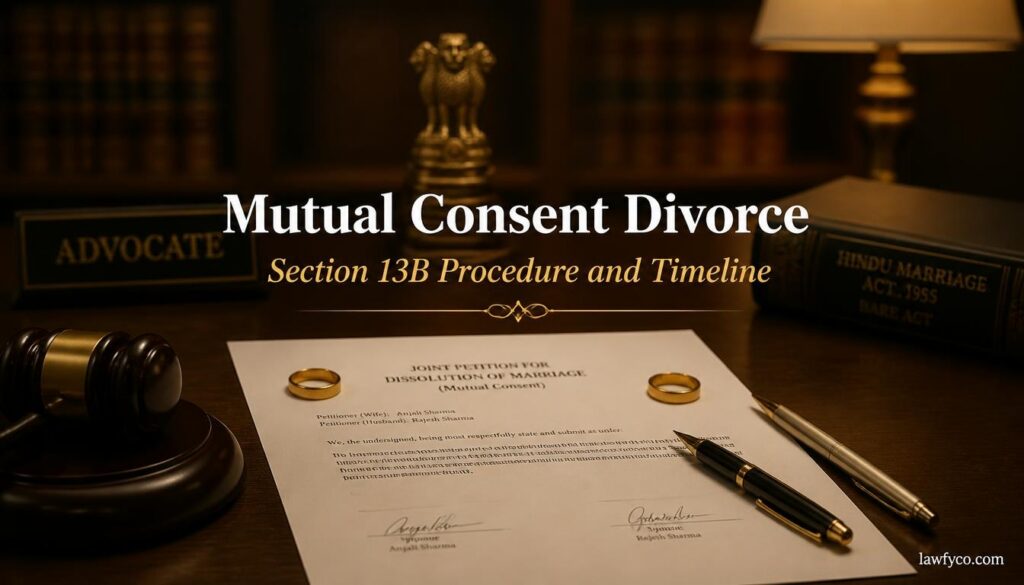
Last reviewed: November 2026
Mutual consent divorce is the route for spouses who have both decided that the marriage cannot continue and who agree on the terms of separation. It avoids the allegations and the long trial of a contested divorce, but it is still a court process with fixed steps, fixed time limits and documents that must be in order.
This guide explains the mutual divorce procedure under Section 13B of the Hindu Marriage Act, 1955, the mutual divorce process in India step by step, the timeline between the first and second motion, when the six-month waiting period can be waived, the documents required, how child custody and alimony are handled, and how mutual divorce in Surat is filed in the Family Court.
Key Insights
Table of Contents
Planning a mutual consent divorce in Surat?
Speak to the Lawfy & Co. Surat team about your matter.
What Is Mutual Consent Divorce? (Meaning)
A mutual divorce, or divorce by mutual consent, is a divorce in which both spouses jointly ask the court to dissolve the marriage. No spouse has to prove fault, cruelty or desertion. Section 13B was added to the Hindu Marriage Act by the Marriage Laws (Amendment) Act, 1976.
Section 13B applies to marriages under the Hindu Marriage Act, which covers Hindus, Buddhists, Jains and Sikhs. For marriages under other laws, see the next sections.
Section 13B of the Hindu Marriage Act: Conditions
For a petition under Section 13B, the following conditions must be met:
Other Laws: Special Marriage Act and Parsi Act
Marriages governed by other personal laws have their own provisions on divorce by mutual consent.
Mutual Divorce Process in India: Step by Step
Confirm which law governs the marriage, that the spouses have lived separately for one year or more, and that one year has passed since the marriage.
Agree on alimony or a one-time settlement, child custody and visitation, property, and any pending cases between the spouses. Record them in a settlement agreement.
The petition under Section 13B is drafted with affidavits from both spouses and signed by both.
File the petition in the court that has jurisdiction under Section 19 of the Act, with the documents.
Both spouses appear in person. The court records their statements on oath confirming the marriage, the separation, free consent and the settlement terms.
The second motion can be moved after six months and within eighteen months of the first motion, unless the court waives the six months.
Both spouses appear again. If the petition has not been withdrawn and the court is satisfied that the consent continues, it passes the decree of divorce.

Need help with a mutual consent divorce petition in Surat?
Our Surat office is at Athwalines, opposite the New Court. Call or WhatsApp us with the basic facts and the documents you have.
Mutual Divorce Timeline: First Motion, Waiting Period and Second Motion
Can the Six-Month Waiting Period Be Waived?
Yes, in the right case. In Amardeep Singh v. Harveen Kaur (2017), the Supreme Court held that the six-month period in Section 13B(2) is directory and not mandatory. A court can waive it where the following conditions are met:
The Supreme Court can also dissolve a marriage directly under Article 142 of the Constitution. In Shilpa Sailesh v. Varun Sreenivasan (2023), it held that it can do so even without mutual consent where the marriage has irretrievably broken down.
Documents Required for Mutual Divorce
The documents commonly required for a mutual divorce petition are:
The court examines each case on its own facts and may ask for additional documents.
Mutual Divorce Child Custody, Alimony and Settlement
The settlement agreement is the heart of a mutual divorce. It should clearly deal with:
The Hindu Marriage Act has provisions on money and children. Section 24 deals with interim maintenance during proceedings, Section 25 with permanent alimony, and Section 26 with the custody, maintenance and education of children.
On mutual divorce child custody, the welfare and best interests of the child remain the paramount consideration. Custody is not a bargain to be traded against money or property, and the court can pass orders about the children under Section 26.
Withdrawal of Consent Before the Decree
Consent is not a one-time act. In Sureshta Devi v. Om Prakash (1991), the Supreme Court held that mutual consent must continue until the decree of divorce is passed, and that either spouse can withdraw consent before the decree. If consent is no longer there at the time of the inquiry, the court cannot pass a decree of divorce by mutual consent.
In Hitesh Bhatnagar v. Deepa Bhatnagar (2011), the Supreme Court again held that a decree under Section 13B can be passed only on the continued mutual consent of the parties, and that one party may withdraw consent at any time before the decree is passed. The court must also be satisfied that the consent was not obtained by force, fraud or undue influence.
Mutual Divorce in Surat: Family Court and Gujarat Procedure
The mutual divorce procedure in Gujarat is the same as in the rest of India, because Section 13B is a central law. What decides where the petition is filed is Section 19 of the Hindu Marriage Act. The petition is presented to the court within whose local limits:
The District Court, Surat has Family Courts at Surat, Bardoli and Mandvi, and its notice records that the Family Courts maintain a panel of counsellors who aid and advise the parties in settling matrimonial disputes. A petition for family court Surat mutual divorce is therefore heard by the Family Court for the area determined by Section 19. Proceedings under the Hindu Marriage Act are held in camera, which means in private.
Court locations, filing counters and e-filing facilities change from time to time, so check the District Court, Surat website or the court registry for the current location and process.
Lawfy & Co. Surat Office
Speak to Our Surat Team
If you need guidance on a mutual consent divorce, a settlement agreement or a child custody question, call or WhatsApp the Lawfy & Co. Surat office. Share the basic facts and the documents you have, and the team will explain the possible next steps.
सूरत ऑफिस से संपर्क करें
Contacting the office does not by itself create an advocate-client relationship.
7 Hiral Arcade, 3rd Floor, Opposite New Court, Meghdoot Society, Athwalines, Athwa, Surat, Gujarat 395007
Phone: +91 91471 09222
Email: ask@lawfyco.in
WhatsApp: +91 91471 09222
Also Read
Frequently Asked Questions
What is mutual consent divorce under Section 13B?
Mutual consent divorce under Section 13B of the Hindu Marriage Act is a divorce for which both spouses file a joint petition. They must have lived separately for one year or more, must not be able to live together, and must have mutually agreed that the marriage should be dissolved.
How long does mutual divorce take?
The second motion cannot be moved earlier than six months and not later than eighteen months after the first motion, unless the court waives the six months. The spouses must also have lived separately for one year or more before filing.
Can the six-month waiting period be waived?
Yes. In Amardeep Singh v. Harveen Kaur (2017), the Supreme Court held that the six-month period is directory. A court can waive it where the separation and waiting period are already over, mediation has failed, and the spouses have settled all issues including alimony and custody.
What documents are required for mutual divorce?
Commonly required documents are the marriage certificate or other proof of marriage, identity and address proof of both spouses, photographs, proof of separate residence, the settlement agreement, income documents where alimony is involved, and the children’s birth certificates.
How is child custody decided in a mutual divorce?
The spouses record the custody and visitation terms in the settlement agreement. The welfare and best interests of the child remain the paramount consideration, and the court can pass orders about the children under Section 26 of the Hindu Marriage Act.
Can consent be withdrawn before the divorce decree?
Yes. Mutual consent must continue until the decree is passed, and either spouse can withdraw consent before the decree, as held by the Supreme Court in Sureshta Devi v. Om Prakash (1991) and Hitesh Bhatnagar v. Deepa Bhatnagar (2011).
Where is a mutual divorce filed in Surat?
It is filed before the court that has jurisdiction under Section 19 of the Hindu Marriage Act, which is the Family Court for the area where the marriage was solemnised, where the respondent resides, where the parties last resided together or, for a wife petitioner, where she resides. The District Court, Surat has Family Courts at Surat, Bardoli and Mandvi.
हिंदी सवाल-जवाब
आपसी सहमति से तलाक (म्यूचुअल डिवोर्स) की प्रक्रिया क्या है?
हिंदू विवाह अधिनियम की धारा 13B के तहत पति-पत्नी संयुक्त याचिका दाखिल करते हैं। दोनों कम से कम एक साल से अलग रह रहे हों और तलाक के लिए आपसी सहमति हो। पहले प्रस्ताव (first motion) के बाद छह महीने से पहले और अठारह महीने के बाद नहीं, दूसरा प्रस्ताव (second motion) दाखिल होता है, और अदालत तलाक की डिक्री देती है।
म्यूचुअल डिवोर्स में कितना समय लगता है?
पहले और दूसरे प्रस्ताव के बीच कम से कम छह महीने का अंतर होता है और अधिकतम अठारह महीने। सुप्रीम कोर्ट ने Amardeep Singh v. Harveen Kaur (2017) में कहा कि कुछ शर्तें पूरी होने पर अदालत यह छह महीने की अवधि माफ़ कर सकती है।
क्या म्यूचुअल डिवोर्स में सहमति वापस ली जा सकती है?
हाँ। तलाक की डिक्री पास होने तक आपसी सहमति बनी रहनी चाहिए, और कोई भी पक्ष डिक्री से पहले अपनी सहमति वापस ले सकता है। यह सुप्रीम कोर्ट ने Sureshta Devi v. Om Prakash (1991) में कहा है।
The information in this article is for general informational purposes only and does not constitute legal advice. No attorney-client relationship is formed by reading this content.
Related Insights

Section 406 IPC: Criminal Breach of Trust and How It Differs from Cheating (Surat)
A guide to Section 406 IPC and BNS 316 covering criminal breach of trust, punishment, bail, the difference from cheating, partnership disputes and Surat courts.
Read Article →
Delhi High Court POCSO Case: POCSO Sentence Suspension Granted During Pendency of Appeal
Read Article →
Forgery under IPC Sections 463 to 471 and BNS: Punishment and Defences (Surat)
A guide to forgery under IPC 463 to 471 and BNS 335 to 340: punishment, bail, the Supreme Court on false documents, defences and forgery cases in Surat.
Read Article →